Think first, then prompt
The five-minute rule for emails, plans, analyses and ideas. Your own first attempt becomes the benchmark you judge the AI against, and your prompts get better as a by-product.
The problem
AI tools are genuinely useful. They explain, summarise, draft and get you unstuck in seconds. That speed is also what makes them easy to lean on in ways you don’t notice.
None of this is a reason to stop using AI. It’s a reason to use it with your mind switched on.
In a study of 758 BCG consultants, those using AI on a task just outside its abilities were 19 percentage points less likely to reach the correct answer. The AI’s answer looked convincing, and many simply accepted it.
Reading a clear explanation feels like learning. But performance right now and what you can still do later, without help, often move in opposite directions.
Without your own first attempt, you have nothing to judge the output against. And when everyone starts from the same suggestions, everyone’s ideas start to look alike.
A 2026 study in Science tested 11 leading AI systems: on average they affirmed users’ actions 49% more often than other humans did. People rated the flattering AI as more trustworthy.
The approach
How to Think in the Age of AI doesn’t ask you to give up the tools. It shows you how to question them, verify them, learn with them and use them deliberately, so the work stays yours.
Researchers at Microsoft and Carnegie Mellon found that AI doesn’t remove thinking; it moves it, toward verifying, integrating and steering. The more you use AI, the more your value lies in judgment.
“The tool is rarely the deciding factor. How you use it is.”
What you’ll learn
Part I explains what AI is good and bad at, the hidden cost of offloading your thinking, and why easy can feel like learning. Then the book gets practical.
The five-minute rule for emails, plans, analyses and ideas. Your own first attempt becomes the benchmark you judge the AI against, and your prompts get better as a by-product.
What a lawyer with thirty years’ experience learned from citing cases that didn’t exist, how automation bias works, and a verification ladder that scales checking to the stakes.
Why chatbots tend to flatter, how to spot it with the Mirror Test, and how to ask for honesty instead of agreement.
Writing is where gaps and shaky assumptions show up. Learn what gets lost when AI writes for you, and simple habits that keep your thinking, and your voice, your own.
In one study, developers who asked conceptual questions and wrote the code themselves scored 65–86% on a skills quiz; those who delegated scored below 40%. Learn the coaching patterns that build skill.
“Centaurs” and “cyborgs”: two styles of working with AI that both succeed because the human stays in charge. Map your own tasks into Me, AI and Together.
When answers become cheap, the skills that grow in value are asking good questions, judgment under uncertainty, domain expertise, taste, human connection and accountability. Each comes with a practice.
Good intentions fade; systems last. Write a one-page AI Use Policy: what’s always fine, what needs thinking first, what you always verify, and what stays human only.
Inside the book
Everything below is part of the ebook itself, in the same PDF. There are no separate bonuses or add-ons.
Every chapter closes with Key Ideas and a short Try This exercise, like asking AI five questions about a topic you know well and grading the answers.
Before You Prompt. Before You Trust. Before You Send or Submit. Short enough to screenshot or stick on your wall.
Ready to copy, for honest feedback, the other side, blind spots, neutral comparison, Socratic learning, checking your understanding, verification, originality and decisions.
Four weeks: Notice, Think First, Verify and Write, Learn and Review. Each day points back to the chapter it comes from.
A quick self-check, from “you open an AI tool before you’ve thought about the problem” to “your work has started to sound like everyone else’s.”
Plain-language definitions, plus the studies behind every chapter so you can read the originals and their limitations.
“I’m learning AI. Don’t give answers. Ask me one guiding question at a time and give a hint only if I’m stuck twice.”
Look inside
Studies are explained in plain language along with their limitations. Many are early, small or survey-based, and the book says so.
Actual pages from the ebook. Tap to enlarge.
Pick a topic you know very well. Ask an AI assistant five detailed questions about it. Mark each answer as correct, partly correct or wrong. Notice how the tone of the wrong answers compares with the right ones.
Who it’s for
About the author
{{ authorBio }}
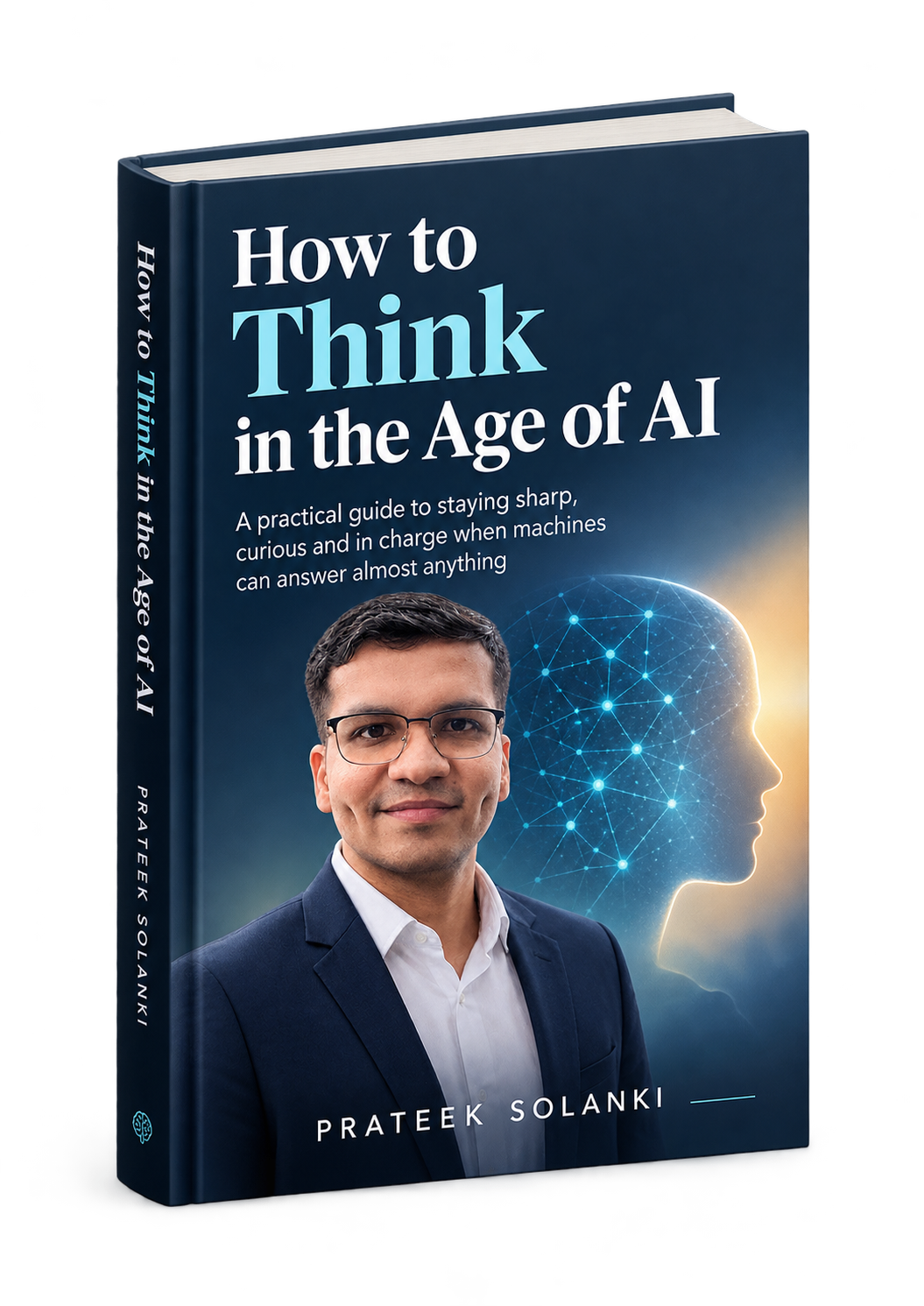
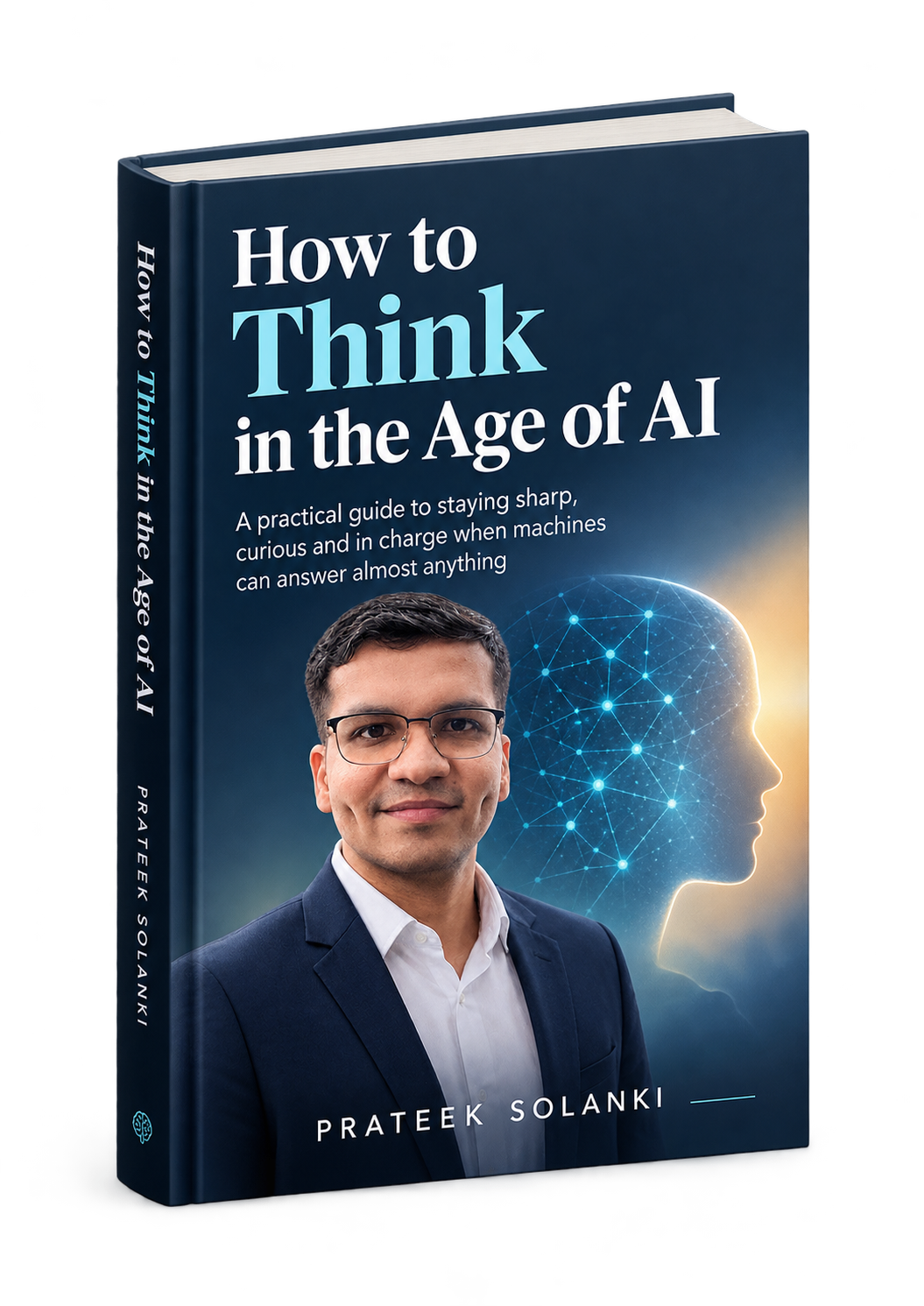
Prateek Solanki wrote How to Think in the Age of AI for readers who want the productivity of AI without giving up the habits that let them judge it: thinking first, checking carefully and staying responsible for the result.
Questions
How to use AI tools without losing the ability to think, learn and judge for yourself. It explains what research has found about thinking alongside AI, then gives you practical habits: thinking before you prompt, verifying before you trust, watching for flattery, writing to clarify your thinking, and learning with AI rather than through it.
Students, professionals, managers, parents and curious people who use AI tools, or are about to, and want those tools to make them sharper rather than duller.
No. You don’t need to know how models are trained, what a “token” is, or which model is newest. The book focuses on how a human mind should work alongside a capable machine, which doesn’t go out of date.
Not as a technical subject. It includes nine ready-to-use prompts designed to make you think, and it shows how clearer thinking produces better prompts. In the book’s words, “Most ‘prompt engineering’ is really just clear thinking written down.”
No. It’s a practical guide to thinking well while you use them, not a technical manual or a tool tutorial. It works alongside whatever AI tools you already use.
A 61-page PDF you can read on a computer, tablet or phone, and print if you like. No physical copy is shipped.
When your payment is complete, the payment provider redirects you to a thank-you page with a “Download your ebook” button. Click it to save the PDF to your device.
The download page is designed to appear as soon as your payment goes through. If you aren’t redirected, or the download doesn’t work, please get in touch using the contact link at the bottom of this page.
Yes, and the book says so up front. It was researched and drafted with AI assistance, then reviewed and edited by the author, with research summaries checked against the sources listed in the Notes.
{{ refundSummary }}
From the Conclusion